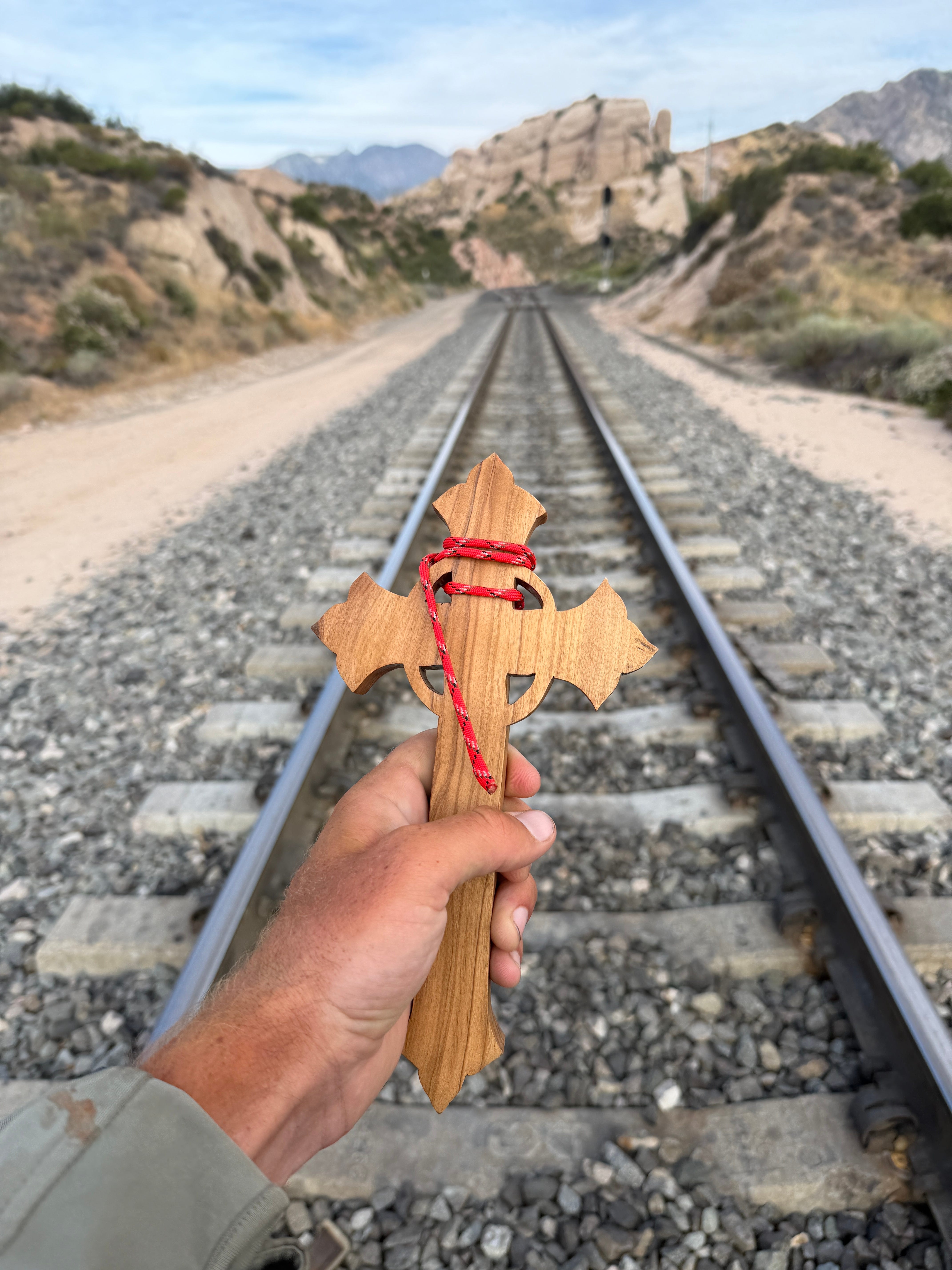
I have been thinking a lot about prayer as I have been in the woods, and as I don’t have the internet or books or big Bibles most of the time, I am limited to the prayers I have memorized. I am working on a larger essay about the act of prayer generally but I am writing this short essay as a preview and introduction. This essay will be unpacking the Lord’s Prayer to the extent that I understand it.
The Lord’s Prayer appears in both the Gospel of Mathew and the Gospel of Luke and in both cases it is given to us by Jesus. In Luke 11:2-4, Jesus gives the prayer when his disciples ask him “how do we pray?”
In Matthew 6:9-13, Jesus gives the prayer as part of his sermon on the Mount when he as he is rebuking long, public, and extravagant prayer.
Jesus says not to pray extravagantly primarily due to the reality that those who exalt themselves by the skill of their prayer make their blessing only Earthly: to enhance reputation.
The less obvious reason Jesus rebukes extravagant, personal, emotional prayer is that “your father knows what you need before you ask him.” This is the point that I think frames the structure of the prayer—that prayer is not about asking God for things but about coming into God’s will. It is about making ourselves want what God in his infinite wisdom gives us.
This prayer is packed with wisdom and power and is found directly in the Bible. To me it is surprising that it is not the source of annual sermons in every church ranging from this most to the least traditional. And yet, it is said blandly and often ignored by many. But it has been a fascination of mine in the woods!
—So without further delay, let’s dive in line by line and just scrape the surface of the infinite wisdom of Christ.
There are two things I will ask you to keep in mind throughout this prayer, the first is the present tense of the prayer, the second is that it is said in the first person plural. +The collective “our” and “we” of the first person plural remind us that we neither are nor should be alone, this prayer and our live as Christians are not “individual” but “collective.” We are firstly members of the body of the Church, the bride of Christ, we are not individuals acting alone. +The present tense shows that the prayer is simultaneously a request, a promise, and acknowledgement/praise.
Our Father, which art in heaven,
God is our father, we are his sons and daughters, we are bearers of his divine image. At the same time of our filial connection to God, he is also the transcendent divinity of the heavens beyond our existence and comprehension.
Hallowed be thy Name,
The Lord’s name is holy (obviously) and so we say this as acknowledgment and praise. But also as we pray this we vow to make it holy ourselves. This is not a request but a promise to fulfill our responsibility as humans and as Christians. This is a calling and sacred oath for us to shape our lives around.
Thy kingdom come,
The LORD’s kingdom is coming in the eschatological (end times) sense—yes. But also, the kingdom is always coming and has already come in the person of Jesus. “The Kingdom of God is within you” “the kingdom of heaven is at hand” etc. This is less of a request for God’s action but an acknowledgment of it! It also reveals part of our responsibility.
Thy will be done, on earth as it is in heaven.
And so this continues as we promise to make Earth like heaven. This is not a boast of our power, nor fantastical Utopianism, it is a summation of the life of the Christian. We are to bring the glory of the Lord into the world as the glory of the Lord has been brought into us! This acknowledges both God’s supreme power that nothing can happen unless he allows it, but also our responsibility to carry out his will. Beauty, goodness, truth and love are the qualities of heaven and the result of God’s will being done—so too should they be the signs of a Christian society.
Give us this day our daily bread;
Here we acknowledge our own powerlessness, we cannot continue in our service without that spiritual food and drink of the Lord which sustains us. We are in need of sustaining not once, not occasionally, but always, every day. And so we return to Christ every day for this sustaining.
The point of Holy Communion and the Christian life of which it is the summation is:
“that our sinful bodies may be made clean by his body, and our souls washed through his most precious blood, and that we may evermore dwell in him, and he in us”
We are to become little Christs by consuming Christ!!!
And forgive us our trespasses, As we forgive them that trespass against us;
And the reason we need this sustaining is because we constantly destroy ourselves through our sinning. We ask for mercy with the promise that we will also be merciful to those who sin against us. We promise to love and forgive not to earn our salvation but because of it.
And lead us not into temptation, But deliver us from evil.
The prayer ends with the only actual request that we really make for the future. This request is not for prosperity, nor for happiness, but to give us a burden we can bear. This acknowledges that nothing happens without God’s willing, God only allows as many demons around a man as he can withstand. And so we pray for direction, and in our kneeling, looking up, and praising God we find our compass and the so prayer works.
For thine is the kingdom, the power, and the glory, For ever and ever. Amen.
This addendum is not in the Bible but is a liturgical invention of the first century. Roman Catholics separate this from the Lord’s Prayer by a few moments but still say it. Either way it is an embellishment. A beautiful, spiritual decoration. The wording of seems to spiral up into heaven as we lift our hearts and minds eye spiritually to heaven for guidance throughout this prayer.
Stay tuned for the rest of the thought…