This is the academic version submitted to faculty who are scholars on the subjects involved. I will be publishing a weekly series that is personalized and less academically stilted in the following weeks.
Introduction
It is a great mystery how profoundly man is moved by art: sonnets and symphonies, grand murals and guitar solos. Stranger still it is that artist and physical medium can be so far surpassed in beauty and power by the art itself. C.S. Lewis describes this stirring incited by art as a longing for a far-off country. Great and diverse thinkers ranging from Emerson to Augustine have thought this disproportionate power of art suggests that it mediates something beyond itself, that its effects do not come from it but through it. Lewis writes: “It was not in them, it only came through them, and what came through them was longing”(Weight of Glory30). Lewis’ claim is that it is not artistic material which man longs for, but that art awakens the desire for something else which is greater and more real. Long predating Lewis, Plato offers a philosophical foundation to Lewis’ intuition with his account of a higher reality than human perception—“the intelligible realm.” In this realm reside transcendent forms: truth, beauty, and goodness in their fullness. These transcendent forms, partially encountered, draw man beyond the immediate sensory and the merely rational—awakening a desire for something higher than either sense or reason can contain. This essay argues that art, when functioning properly, becomes a medium of this transcendence.
Human beings do not only suffer from being detached from transcendent reality; they also suffer from being divided within themselves. Man can understand something abstractly or can participate in it experientially, but seldom at once. One either understands pain as an abstract idea or feels it concretely as he suffers, but the two modes of knowing inevitably pull apart. Because of this internal division of person, humans are diminished from what they could be, they have less being. Lewis proclaims that art, namely myth, bridges the horizontal divide within man, unifying him as it pulls into truth.
Poet-Priest Malcolm Guite articulates that man’s perceptive faculty is shrouded by his own knowledge and senses, occluding the true radiance of reality. Guite suggests, the solution to lifting the obscuring veil of perception is not through transparency but through artistic coloration. The walls of the cave cannot be smashed through and made into skylights, nor can they be replaced with TV broadcasts of the world outside. To help his brethren in this cave of ignorance, the artist creates a stained-glass window: carefully shaping and constructing the colorful panels, not assuming to show the true world and yet allowing diverse and true light to shine into the cave. Stained glass and art alike refract the true and blinding light into radiant color, painting the world anew, and allowing eyes to see the sun without being blinded. Guite’s chief contribution is that it is the imagination by which humans receive true sight, true perception, and true understanding through art.
Among the redemptive and liberating arts, storytelling, and the genre of fantasy in particular have been especially maligned as being unreal, childish, and escapist: a distraction from real work, knowledge, and progress. And although primarily levied at fantasy, all art is vulnerable to this attack as it works through image and symbol. The accusation rings: why does the artist not make a clear window out from the cave? Furthermore, how could any artist who is himself in the darkness make anything but further darkness? Plato himself gives voice to the classical form of this suspicion of the creative arts in The Republic. In “On Fairy-Stories” J.R.R. Tolkien makes his descriptive defense of himself and his fellow imaginative artists. Tolkien claims that art is not a harmful distraction, it is in fact a healing medicine. He argues man’s rightful place is not in the enslaving darkness of ignorance but in the emancipating radiance of awareness, and that the artist, just as the philosopher, has a real part to play in this liberation. This essay endeavors to prove that properly understood, creative art does not confuse man from reality but connects him to it.
At stake in this paper is the claim that Tolkien’s theory of sub-creation is a holistic articulation of what art is and does when it functions redemptively—bringing man into fuller being by unifying and growing his soul. Plato lays the foundation and reveals man’s need for liberation and ascension. Lewis names myth as a working bridge to the beyond, explaining its workings and effects. Guite gives name to this crossing, and reveals imagination as its mode. Finally, Middle-earth is the proof, a fantastic secondary world so true the reader encounters it as lived reality, entering inside it to love, to know, and to become.
Plato: Establishing Ignorance and Introducing Transcendence
Millennia before any inkling put pen to paper the questions of perception and of being were introduced by Plato. In Plato is also found the foundation for the solution the mythopoeic thinkers will put forward. Plato’s contribution can be seen in his allegory of the cave. In this cave prisoners are chained with their vision directed towards the inner wall. Across this wall move shadows cast by models of real things against the fire inside the cave. Plato posits “what people in that situation would think of as the truth would be nothing but the shadows of the manufactured objects behind them” (515c). The prisoners could not know that, in addition to the shadows, the puppets and firelight are also artificial so they are doubly deceived. If they were to break free of their chains they would only move towards the shadows, deeper into the cave; it is their inverted orientation that is their deepest problem. The prisoners are analogues for uneducated humans, and the walls of the cave represent the limits of their perception.
The liberation of these prisoners is painful; not only must they accept their world to have been a deception, but they must also suffer to know the real world. Plato says the prisoner must be forced, dragged up to the real world where he would be dazzled and blinded at first by the light of the sun (516a). The road to truth is in fact so brutal that seemingly no man would make it unless dragged there unwillingly. So, the question is raised: if direct exposure to naked true light is blinding, can there be some other medium by or through which the prisoner can receive this true light?
But before that question can be answered, it must be clarified what the sun represents within the allegory. Plato says, “the sun is not only the cause of things being seen, but of their coming into being, their growth and their sustenance” (509b). As the cause of “things being seen,” the sun makes things visible; without it nothing can be seen or known. As the cause of “their coming into being” the sun is the source of existence from which each other form derives its being. Finally, as the source of “their growth and their sustenance” the sun is the source of development; it sustains and nourishes over time. So the sun is the source of knowing, being, and becoming. The sun is the analogue of the form of the good in the visible realm; it is not one form among others but the highest principle from which the others flow. Plato says that to ascend towards the Good is not only to accumulate knowledge, but to participate more fully in true reality; one does not merely know more, one becomes more. By growth into being, this essay means the soul’s movement into fuller participation in truth, goodness, and reality, as the person becomes more truly who and what they are meant to be. This is made visible in the gradual ascent of the prisoner: “He’d need time to adjust… first he’d find it easiest to see shadows; next it would be reflections of human beings and everything else in water, then the things themselves” (516a). As the prisoner’s vision moves to brighter and more real objects, his capacity to perceive, and so his soul, must also grow. Each object is not just a truth acquired but a transformation. Education then, in the deepest Platonic sense is the growth and orientation of the soul to the source of its own being. So man must suffer and labor to come to see the form of the good, and as he does he will grow from what he is into what he was meant to be.
Plato’s account also implies a second problem, that there is a vast epistemic divide between the philosopher who has seen the real world and his brethren still in the cave. Even if he could convince and by some means explain to them the reality outside the cave, he could not transmit the experience of being in the real world. Even if they could grasp the facts of reality, they could not have the appropriate response to it without themselves experiencing it. This is why Plato says that they would hate this philosopher, thinking him a fool to have lessened his perception of shadows through his study of light, and likely despising him and killing him for it (517a). Growing into being, the escaping of the cave, truly seeing—these are difficult and even fatal tasks, the striving towards them is for Plato, valiant albeit doomed. But beyond Plato there is hope.
Plato says that many painters and poets are deceivers, that they “awaken and nourish the irrational part of the soul and, by making it strong, destroy the rational part” (605b). Plato is not dismissive of the creative arts—he fears them because of how seriously he takes their ability to shape the soul. Plato knows that art which shapes the soul away from the good is truly dangerous. Yet, Plato does not banish all poetry. At the end of book III he permits “hymns to the gods and praises of good men”(398a). Plato’s criterion for permissible art is specific: it must praise the divine good and orient the soul towards it. The graduated ascent of the prisoner towards the sun requires lesser lights; poetry, music, and creative art in general may help if they are good and not deceptive—stars and not fires inside the cave. The true problem for Plato then is not poetry’s capability to hold virtue but the poet’s ability to discern it. In book X Plato says that the imitating poet has no knowledge of what he imitates and so does not know if he leads towards the good or away from it. The poet is very powerful, either for good or for ill; therefore it is crucial to ensure the poet discerns what is actually good. Plato himself is reluctant to define this good, “it seems to me too big a question for the present occasion,” and moves to describe an image of it rather than the thing itself(506e). Plato is ascending to a good which he cannot encounter, so while the poets who rightly praise the gods are permissible—Plato cannot say confidently who they are.
Plato does resolve that there is a necessary, graduated ascent to truth, and so requires musical and poetic education for the shaping of his guards. What Plato leaves unresolved is not whether the soul requires mediated education, but what truly trustworthy poetic and artistic mediation looks like. The question of how to grow prisoners into philosophers without confusing them is unspecified. Of this praiseworthy transcendent good which Plato is uncertain to identify, there are Christian and mythopoeic thinkers who gladly give a view of what it is. These men have such confidence not out of superiority over Plato, but because where Plato cannot quite ascend to the good, the good has in their account descended to meet them.
Tolkien: Introducing Sub-Creation as True Illumination
For Tolkien also the highest truth cannot be approached directly without overwhelming the finite mind—the Ark of the Covenant kills even the well-intentioned who touch it improperly. However, Tolkien is much more generous than Plato about the imaginative mediums which may educate the soul, Tolkien is himself one of the good poets. To Tolkien the artist certainly does not cast shadows in the cave but is a creator of those viewable reflections which educate the escapee. In “On Fairy-Stories” Tolkien explains how this is possible, and in Mythopoeia he shows what it looks like.
The question of why man creates art is central to Tolkien. His artistic imagination is not the trade of Sophists but rather something endowed in human existence. For Tolkien the true artist does not make derivative propaganda, lies or distractions—neither does he want to. Tolkien’s view of art is not primarily aesthetic, but theological. He says: “we make still by the law in which we were made” (Mythopoeia lines 104-07). For Tolkien, mankind must create art because he is made in the image of a creator; each work of art is an attempt to participate in creation. Furthermore, each artist still carries something of the light from his creation.
Tolkien writes of this light again in his poem to Lewis “Mythopoeia”:
“man, sub-creator, the refracted light
through whom is splintered from a single White
to many hues, and endlessly combined
in living shapes that move from mind to mind”
Tolkien writes this for a struggling Lewis—who was upset knowing that myths he loved were merely beautiful lies—in order to reframe myth as a good refraction of real truth. The sub-creator does not “make up” myth from nothing; he diffuses the incomprehensible and singular divine truth through his own worldly self into something other people can see. With Tolkien’s understanding of creative art, a myth like that of Cupid and Psyche ceases to be a lie breathed through silver and begins to be wrapped in unfamiliarity—this is a life-changing shift for Lewis. From the undrinkable divine liquor, the sub-creator distills, through his ragged earthy self, a brew which may be drunk.
Tolkien does not make this grand claim of the artist without humility. He confesses that “the fairy gold all too often turns to leaves when it is brought away,” and he asks that his readers “receive his withered leaves, as a token that my hand at least once held a little of the gold” (Fairy Stories1). The materials and instruments of the sub-creator are like him—fallen and imperfect, in need of grace.
The conception of sub-creative art which is distilled stylistically in Mythopoeia is divulged systematically in “On Fairy-Stories”. Tolkien writes “Fantasy is, I think, not a lower but a higher form of Art, indeed the most nearly pure form, and so (when achieved) the most potent” (27). For Tolkien, this “genre” of Fantasy is not merely one of childish falsities, but the labored creation of a disciplined artist. If something is true fantasy, and thereby true art, it cannot be a whimsical or weaponized creation of some arbitrary world. It must be a genuine reflection of that greater light; this is why Tolkien fiercely maintains the secondary world must have “the inner consistency of reality.” This does not just mean mere mechanistic functionality, it requires a moral authenticity. For this reason it follows that like any other art, it must be created for the sake of itself, not coded to prove some point or win some argument. This is why Tolkien does not encode theological lessons to be learned in fictitious forms but transmits a real world in which theological reality is naturally experienced as lived truth. Sub-creation is therefore, necessarily participatory.
Man needs sub-creation, for though man is made in the image of God, he often exists as dimmed—the acuity of his refraction made dull by habit and familiarity. His faculties of seeing and knowing are streamlined to mere identification of category. He writes “we need, in any case, to clean our windows; so that the things seen clearly may be freed from the drab blur of triteness or familiarity”(28). Recovery is what Tolkien names sub-creation’s solution to this problem. Recovery is the restoration of man’s original and intended perception through sub-creation. Tolkien writes that what is most in need of recovery is that which is closest to man: “Of all faces those of our familiares are the ones both most difficult to play fantastic tricks with, and most difficult to see with fresh attention” (28). Sub-creative fantasy makes the familiar strange enough to be truly seen again. Just as Tolkien says “by the making of Pegasus, horses were ennobled” so too are gardens reenchanted by the shire, and humanity re-dignified by the non-human peoples of Middle-earth(29). Recovery restores man’s vision of things around him—but sub-creation does not stop at horizontal rehabilitation. There is a second movement in Tolkien’s account which surpasses the horizontal unification of perception: that is vertical reception.
Tolkien calls this moment Eucatastrophe—“the sudden joyous turn”—and he argues it is the highest function of a true fairy tale. This is the moment when all else seems lost and in some final unlikely turn at the last second comes, “a sudden and miraculous grace”(33). This rescue is not a denial of darkness, but a denial of its final triumph. In this sudden turn to joy out of darkness there is a moment of vertical penetration connecting the transcendent to the earthly in a flash of grace. Eucatastrophe is described with more theological precision than mere happiness, Tolkien describes it as “a fleeting glimpse of Joy, Joy beyond the walls of the world, poignant as grief”(33). The joy and pain are both real, but, in the end the joy wins.
The eucatastrophic glimpse is not an argument and neither is it a proposition. It is a felt experience of the sub-created reality’s structure—the reader is both experiencing the narrative from inside and conscious of that which transcends it. In the eucatastrophic flash, man’s head and his heart are united by something neither analysis nor emotion could alone produce. Recovery and Eucatastrophe are two parts of a shared act—recovery restoring perception of the ordinary, and Eucatastrophe transcending vision to higher forms. Together they do what Tolkien claims of the sub-creative act; addressing the entire person, uniting experience together with meaning in the singular action of receiving.
Tolkien goes beyond arguing this theory—fittingly, he writes it into a story called “Leaf by Niggle.” In this fiction, a painter labors away painstakingly on a great tree which he cannot finish: each leaf demands another branch, each branch demanding other leaves, and so on. One day he moves beyond this world where he finds the real tree which he had spent his life trying to paint. This tree, being real, is more beautiful, more “tree” than any canvas and paint could have contained. Tolkien reveals in his letters that he is in a sense Niggle, and Middle-earth is the great tree which he is blessed to see but unable to finish. The withered leaves Tolkien asks his audience to receive are Niggle’s incomplete paintings of a true and beautiful tree—broken and genuine, reaching towards something which was always already there.
Tolkien develops the idea that sub-creative art can both restore sight and mediate truths above ordinary perception; the question that remains is how such mediation is possible? It is here that Lewis becomes helpful; he explains how it is that the higher may come through the lower. Lewis’ formulation does not replace Tolkien’s but gives further language and explanation to what Tolkien introduces. In his abundance of production Lewis helps to clarify the elements of transposition, myth, meaning, and experience.
Lewis: Explaining Tolkien’s Sub-Created Path
Lewis’ idea of longing, which opened this essay, is more than an emotional phenomenon—it is evidence that beauty works as a mediator rather than an end. Lewis argues that what matters in beautiful things is not the things themselves but what they transmit: “For they are not the thing itself; they are only the scent of a flower we have not found, the echo of a tune we have not heard” (“The Weight of Glory”31). Lewis divulges beauty’s structural role as a mediator; it is neither fulfilment nor illusion but a medium through which the transcendent is glimpsed by the non-transcendent. The question that follows this assertion is of how the higher can be present in the lower without being reduced to it; this is the question which Lewis seeks to answer in “Transposition.”
Lewis calls the way by which a higher reality is genuinely communicated through the lower “Transposition.” For Lewis, the relative poverty of the material comprising the lower medium does not make it false, it only obscures the richness of the truth which it transmits. This partial transmission is not exhaustive, algebraic, or necessarily obvious, but it is with the right vision, true. This is essential to the greater argument about art’s ability to be a transcendent connector. Fittingly, Lewis illustrates this idea through a parable.
Lewis moves from abstract principle into vivid image with the story of a boy raised in a dungeon. In this story a boy is born in a dungeon without clear view of the outside world; inside the dungeon, his mother—the artist, attempts to educate him of the outside world with pictures using pencil and paper. The mother is a good artist and tries honorably to educate her son, who knows no true reality except what his mother gives to him. Then, upon finding out that the outside world does not consist of pencil lines the boy is devastated and lost. The drawings were true drawings, they illustrated reality as well as drawings could—but they were not themselves reality. The boy’s problem is not that the pencil drawings were false, they were good drawings; his problem is that he cannot yet imagine what the drawings were transpositions of. The mistake of the boy is the fear of Plato: to mistake the artistic medium for the reality it reflects. Lewis’ answer to Plato is that the image, if received rightly, is not a mistake—it is a saving grace, the only door available.
The mother’s drawings are not condemned by the confusion of her son because they are vindicated by the reality that awaits him once he leaves the dungeon. About this transposition Lewis writes “The child will get the idea that the real world is somehow less visible than his mother’s pictures. In reality it lacks lines because it is incomprehensibly more visible”(“Transposition”110). This is the payoff of “Transposition”: that true reality is so much realer, it has so much more being than the lines could ever contain. Lewis writes that upon the boy’s escape, upon the convergence of true reality and lived experience: “if they vanish in the risen life, they will vanish only as pencil lines vanish from the real landscape, not as a candle flame that is put out but as a candle flame which has become invisible because someone has pulled up the blind, thrown open the shutters, and let in the blaze of the risen sun”(111). The distinction made here is precise and significant to his argument, that there are two opposite ways a lower medium ceases to be relevant. The first way is that it is negated—the candle is put out, the drawings revealed as lies, the image destroyed by the arrival of reality. This would be the shadows cast on Plato’s cave, extinguished by true light. The second option is fulfilment—the light of the candle minimized by the exceeding radiance of the risen sun. The pencil lines do not vanish because they were lies, they vanish because they fit truly into something so much more actual and distinct than itself. Outlines are made transparent in front of the reality they describe, theology is overfilled by the presence of God, as true reality surpasses its description. Art then, need not rival truth to be its servant; it becomes a necessary and merciful vessel by which truth may first reach finite minds. The higher comes into the lower, the light enters the glass, the myth becomes fact.
Perpendicular to the vertical problem of alignment with the transcendent, is the horizontal problem of integration for the internal perceptive faculties. When understanding transcendent truth, beauty, and goodness, man can either understand a thing intellectually by analytical deconstruction—or he can experience it personally from inside it. Lewis characterizes this while meditating in a toolshed: he first sees the length a beam of light shining in through a crack in the wall, then he enters into the beam and sees leaves and sky and sun through it. Both of the experiences are true, and yet they are different.
At the same time that Lewis wrote “Transposition”, he also produced his famous essay “Myth Became Fact.” In this essay Lewis argues the internal horizontal problem of “Meditation in A Toolshed,” and the transcendent vertical problem of “Transposition” have a common solution: myth.
Lewis again articulates this division of man’s interior perceptive faculties in Myth Became Fact: “Human thought is incurably abstract…Yet the only realities we experience are concrete”(3). He clarifies “This is our dilemma—either to taste and not know or to know and not taste”(3). However, this dilemma is not a cause for dismay, Lewis argues: “Of this tragic dilemma myth is the partial solution”(3). Myth is the bridge which can span the chasm betwixt head and heart. Much like Tolkien’s vertically penetrating moment of eucatastrophe, this bridging only happens as the myth is being delivered; the very real spell is broken the second one tries to get outside it. The apostle Peter begins sinking the moment he thinks about his walking on water. Lewis says “You were not knowing, but tasting; but what you were tasting turns out to be a universal principle”(3). Receiving a myth is by nature an experiential act, like that of tasting, but the taste itself is universal and unchanging. This action is therefore at once both felt and perceived by the heart, and is also universal and so known in the head.
This universality is of course truth, and thereby a transcendent element; this is how myth bridges also vertically from the earthly to the heavenly. Furthermore, this truth is not mere factuality but transcendence: “What flows into you from the myth is not truth but reality”(3). Lewis clarifies that he is not talking about the vernacular meaning of “truth” but of its actual and absolute sense: he argues that truth is necessarily about something, reality is that which truth is about. The ineffable is understood, the invisible made visible.
Lewis has done the hardest conceptual work. He has explained transposition, he has demonstrated man’s disjunction in perception, and he has exalted the role of myth to bridge the gaps both vertical and horizontal. But mechanism is not yet vision, explanation is not yet experience, the meal is prepared and ready but it is not yet bitten into. Where Lewis explains this bridge, Malcolm Guite names how to cross it. With Guite, the conceptual framework of Lewis becomes method.
Guite: How to Walk the Mythopoeic Paths of Escape
Guite is able to articulate most clearly what it is that prevents man from using the bridge that Lewis and Tolkien describe as art, sub-creation, and myth. Guite argues “it is as though there were a film or veil between us and the radiant reality of things”—not an impenetrable wall but a film, a shroud of recognition which clouds true perception (Lifting the Veil 12). This is an expansion of Tolkien’s need to clean the windows in “Recovery.” Guite credits much of the clarity of his sight to the nourishment of Middle-earth and its revealer and is himself also a Mythopoeic thinker and poet.
Guite is the least tolerant of this occluding film and is optimistic of man’s ability to lift it, to look past familiarity, and to see truly. His hopeful invitation is: “look out and see what is really there and to discover that reality is itself numinous, translucent with glimmerings of the supernatural, of something holy shining through it” (11). For Guite, the veil exists but it is not totally opaque; the world behind it is clear and the true light shines through it. As the only priest and the truest poet of the bunch, Guite is able to boldly make the theological claim that underpins this whole paper: the world is not an entirely closed system of materiality. There are cracks and weak points in the material world, places where the light shines through, and true art is able to force open these cracks, if only for a moment, and let the divine light shine forth. Guite does not deny that man is in a cave—he seeks to transform it into a cathedral. Though he may not be able to simply escape his finitude, man has a responsibility to participate in its illumination.
Since the created world is translucent and the veil is the obstacle, then the role of art is clear. Guite states it directly: “the whole purpose of the arts is to awaken the mind’s attention, to remove the film of familiarity” (12). This is Guite’s continuation of Tolkien—the secondary world returns the primary world to what it always was: numinous, saturated with a meaning which habit made invisible. Guite precisely names this cleansing faculty: “the power which art deploys to do these things is the power of imagination”(Guite12). This imagination he insists is not the faculty of making things up but rather of rediscovery. It is the power that sees truly—and is fundamentally theological: “imagination is part of the image of God in us”(13). This is the imago dei argument which also grounds Tolkien’s sub-creation.
Lewis’ boy in the dungeon was given a way out of it through his mother’s art and fell short for lack of imagination. These thinkers agree that the boy will understand the real world when he escapes to it, but Guite encourages the boy, and with him all humanity, to use their imagination because with it drawings move from lines to windows. There are some for whom Eucatastrophe does not yet deliver a flash of joy beyond the world—this is because they still lack the imagination to truly enter in and receive it.
Where Tolkien says man makes because he is made in the image of a creator, Guite elaborates that man perceives truly by imagination because he is made in the image of the original imaginer. This means that the same foundation feeds both the artist’s making and the reader’s receiving. Guite says that it is through, by and because of this imagination that:
“the artist strives to manifest within earthly material those transfiguring glimpses of form and quality which can at any moment shimmer through the stuff of this world: the blaze of unconsuming flame that makes a burning bush” (Guite 20).
The burning bush is the art, the burning bush is the stained glass window through which the light blazes without consuming. The holy shines through the ordinary and does not destroy it but elevates it, transfiguring it.
Guite builds artistically on Tolkien’s development of sub-creation: “the artist and poet, by the magical bodying power of imagination is able to make a body and a home for that fleeting glimpse”( 21). His argument is that sub-creation is giving graspable form to the elusive transcendent. To sub-create is to build a home for what would otherwise escape. This is what Tolkien does so masterfully in Middle-earth.
Middle-earth: The Light Through Tolkien
Many Christian lovers of Tolkien read his Legendarium as an allegory; this is a grand mistake. Tolkien himself remarked often that he hated allegory, it was even a source of contention between him and Lewis. In the foreward to The Lord of the Rings he says that he is insulted by the accusation of his work being a political allegory and that he dislikes allegory in general. He writes of his legendarium in letter 165: “It is not ‘about’ anything but itself. Certainly it has no allegorical intentions.” This is Tolkien’s fervent opposition of reductive criticism, and specifically reductive criticism of authorial intent; that is why this essay will not go into the war, Tolkien’s mother, the specific Catholic priests who raised him, or any such personal background to understand Middle-earth. This essay will understand Middle-earth as intended—from within.
None of this is to say that Tolkien is against truth, beauty or meaning in and through his writing; he writes later in the same letter “the only criticism that annoyed me was that it ‘contained no religion.’ It is a monotheistic world of natural theology”(Tolkien no.165). In The Silmarillion Tolkien demonstrates this clear monotheistic cosmology of Middle-earth in the Ainulindalë where Eru Ilúvatar leads the Ainur in singing the universe into creation. Specifically, he also indicates that this ancient world, though theistic, is very much pre-revelation. There is no distinct religion, scripture, or priesthood; Eru Illuvitar is only known through his created world and by those living in harmony with it. It is because Middle-earth is religious without overt religion that it is so uniquely illuminating to readers in a world full of religion who may have grown blind to the theistic metaphysics of their own world. This is how he can say in letter 142: “The Lord of the Rings is of course a fundamentally religious and Catholic work; unconsciously so at first, but consciously in the revision”(Tolkien no.142). The Christianity of The Lord of the Rings is accidental and metaphysical, woven into the fabric of reality rather than algebraically representative.
All of these thoughts are not contradictory but reveal the tight distinction which Tolkien makes; namely that The Lord of the Rings is true. Tolkien believed that his Legendarium was not his invention but something he discovered or translated; he admits “I have long ceased to invent” (Tolkien no.180).This is why Tolkien really refers to it as history, not as a quirk or boast but in his actual opinion. The Shire is not scoured because Tolkien wants to say something, the Shire is scoured because that is what happens to shires. The Ring does not corrupt because Tolkien is making an over wordy sermon on atomic weapons, but because that is what magic rings do. It is natural, then, for Tolkien to understand that the underlying fabric of a true, revealed world to be similarly ordered to that of his own.
Tolkien, Guite, and this essay argue that Middle-earth is so truly effective at lifting the veil because it is truly foreign, non-allegorical, and theologically true. The foreignness is proved by the lack of orcs, dragons, and Sindarin elvish in the modern world. In addition to Tolkien’s fervent denial of allegory in his works, the proof that Middle-earth is not allegory is evidence of it being something higher; that it is genuine sub-creation. The theological truth of the Legendarium is by its nature something that is only truly known inside the story itself—so at long last the argument must go within this secondary world.
The Ring: Slavery of The Self
The namesake of The Lord of the Rings, the Ring of power itself, is something even more real and core to reality and existence than any mere allegory. Throughout the narrative the reader sees the Ring promising power, knowledge, kingship and happiness and then bringing forth weakness, ignorance, slavery, and misery. The nature of the Ring does not just map on to vice in general, but maps further onto idolatry which all vice ultimately grows towards. In their idolatry, worshipers devolve and diminish into a plane of non-being. This is revelatory of a true and palpable Christian ontology.
Everyone is tempted by the Ring and many, to their doom, succumb to it. It promises Boromir glory and power under the guise that he would use it for good. It promises Galadriel beauty and power unsurpassable. It promises a magnified kingship to the Nazgûl. To each it promises an exalting of their own freedom and power; to each it promises an expansion of their own being. The Ring however, does not give what it promises, and it takes far more. Those who succumb to the Ring do not grow in being, they do not become more of themselves; rather they diminish, becoming distorted inversions of what they once were. Of the effects of the Ring, the devolution of Gollum and the Ringwraiths are most revelatory.
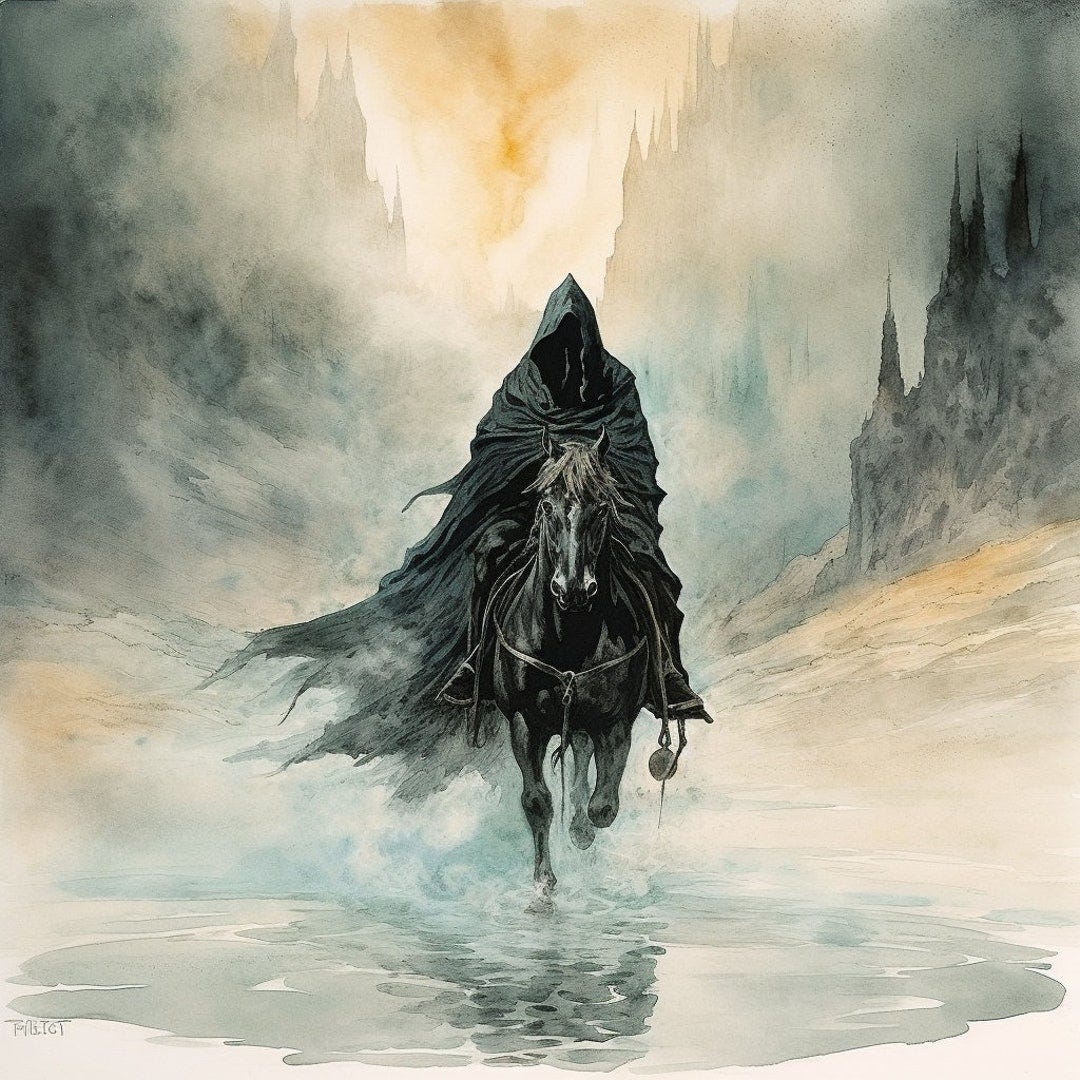
The Ringwraiths were once great kings of men who took rings of power to expand their glory. In taking these rings, they grew enslaved to the rings and to their master the dark lord. Gandalf tells Frodo of what happens to those left under the spell of the ring: “he fades: he becomes in the end invisible permanently, and walks in the twilight under the eye of the dark power that rules the rings”(57). These wraiths are wrathful creatures of shadow; writhing themselves into vacuity, twisted into themselves as miserable wreaths. These creatures are faded, invisible, shadows—they are without shape or form save their guises. They have no will left of their own and cannot die; they are caught in a limbo of miserable agony between life and the release of death. They do not perceive the visible world as bodied creatures do—so averse are they to light, they exist as and see only shadow. They are not monsters full of darkness, but voids, shadows where once stood real and good men. They are by nature vacuous, inversions of light, and being just as their shadowy forms are merely the absence of light. In service to the rings the Great kings diminish in body, in spirit, in power, in freedom and in being—this is the Christian ontology of slavery to sin. The Nazgûl, by valuing their power over goodness are not made evil kings but servants, the promise of vice and of the Ring alike are the same: a lie which ensnares, spiraling downwards into doom and misery.
The Hobbit-creature Sméagol is not kingly but lowly, and although his doom begins and manifests differently, in the end it is the same. The Ring bends his will inward, making him radically possessive, fracturing his identity, isolating him and finally enslaving him. Then the Ring drives him into isolation as he is banished from his community for using it to spy and steal from friend and kin. Finally the Ring dismantles his personhood until he is reduced to a wiry, pale, sub-human creature. Driven from the real world he retreats into the darkness under it and becomes a creature that cannot bear to see it or what it reveals. This is not incidental, but revelatory: the longer he loves the ring, the less he is capable of loving or even bearing reality.
Before the Ring, Sméagol is a jealous and selfish creature although seemingly harmless; once he is possessed by it, his jealousy quickly becomes murderous. The Ring exacerbates Sméagol’s selfishness in cycle which spirals into his exile and destruction. Sméagol himself becomes a captive to the Gollum inside of him. Sméagol seemingly wanted common things like getting a good birthday present—he was not seeking evil and yet, by placing something above all else, the Ring dominated and distorted him into something truly horrible.
Such is the insidious nature of all vice inside and outside Middle-earth, that just one disordered love can tear down a person’s entire life and humanity. Just as Sméagol’s inordinate love of birthday presents ruins him, the Nazgûl’s desire for kingship destroys them, and Boromir’s excessive love of power causes him to betray his friends and break his oath. Bilbo notices that he is beginning down the path of diminishment saying: “I feel thin, sort of stretched, like butter scraped over too much bread”(Tolkien 32).
The story of Sméagol is the relationship of all people to sin: isolating, weakening, fracturing and diminishing. Bilbo’s feeling of being spread thin is the effect of vice on the soul, stretching into disunity, weakness and pain. Turning the person against themselves is not insignificant, it is the empowering of the Gollum within: “he hates and loves the Ring just as he hates and loves himself”(58).
There is no partial subservience to the ring: it demands full enslavement. This promise of the Ring is the lie of all idolatry: “and he saith unto him, All these things will I give thee, if thou wilt fall down and worship me” (Matthew 4.9). In Middle-earth the Ring shows clearly the reality of vice, that it is an act of self-enslavement and that it diminishes man from what he is and could be—into something far less and far lower. In Middle-earth, the Ring reveals the true nature of vice, not empowerment but diminishment, not fullness but shadow. It is therefore no accident that those most overcome by wickedness become creatures of darkness themselves—recoiling from the true light of reality itself.
Galadriel and Gandalf: The Ascending Ontology of Humility
In the character of Galadriel is found a goodness which surpasses her person; her beauty and authority are not self-grounded but bestowed, received and faithfully borne. Her beauty is not erotic or merely aesthetic in nature; it is of a surpassing morality and transcendent goodness. Though she is luminous, she is not the source of the light but a refractor of it. In Middle-earth, light is not just brightness but the visible form of truth, purity and fuller being. This makes Galadriel a positive counter to the Ring: where the Ring offers false enlargement by possession, Galadriel actually grows by reception, surrender and humility. Galadriel is glorified as she becomes transparent to the divine light, letting it shine through. Furthermore, this mediatory goodness is not only an abstract idea for her but becomes materially concentrated inside the plot by her gift to Frodo: the Phial.
Galadriel’s purity is a purity of fidelity, not of innocence; her luminous goodness is far from ignorance. She knows Sauron and his temptation well from the long ages past and from the present temptation she feels within herself. She remembers the corruption beneath his beauty, she remembers the Noldor’s exile—an exile she shared in. The Ring calls to her and she perceives with clarity what she would become through it. If she were to succumb to the Ring, she says, “Instead of a dark lord, you would have a queen, not dark but beautiful and terrible as the dawn!” and so she would become the devouring mother, the tyrannical queen. However, Galadriel does “pass the test” by refusing this false glory and power. In accepting diminishment, she wields a greater light than she could herself possess.
Her gifts to the fellowship each proceed from an aspect of her vast personal nature and power. But all her gifts culminate in the Phial she gives to Frodo; the Phial reveals clearly what Galadriel is. Galadriel does not create the light she bears. In her hair she carries the brilliance of the Two Trees of Valinor. In the Phial she gives to Frodo is the light of Eärendil’s star, which itself contains a reflection of the original light of creation. In each stage of transmission, the light is not generated but borne and handed on. The creatures of Middle-earth do not create light, each can only receive it and pass it on. What Frodo holds is merely a small glass bottle; yet he bears in it a sliver of the ancient light of creation, burning still against darkness. Because of her submission to the greater good, Galadriel’s personal power is extended as her Phial shines against darkness far away.
This specifically female temptation which Galadriel rejects in her diminishing is very real and is embodied in Galadriel’s opposite: the wicked devouring mother Shelob. Galadriel and Shelob alike are matriarchs of Middle-earth both ancient and powerful; however, where Galadriel bears light and gives it freely, Shelob swallows it, seeking only satiation, possession and darkness. Shelob is the realization of what Galadriel is promised by the ring: complete and unopposed dominance, even by the masculine power of Sauron. Yet, Shelob is defeated not by like domination but by humble luminosity. When Frodo and Sam raise the Phial in the tunnel, the light of Eärendil’s star blazes against her and she cannot bear it. She is not wounded by it as a weapon—she is overcome by it just as darkness is defeated by light, because what the Phial carries is the light and truth which she is a perversion. Then in the depths of despair and loneliness Sam cries out “Elbereth Gilthoniel!”—the name of the Vala who hallowed the Silmaril, whose consecration is transmitted to the Phial(729). Sam doesn’t know how or why he says it, and yet the words which come through him force the darkness into retreat! Tolkien shows the ancient light to be more real and more powerful than the consuming darkness it battles against. The theology is not argued but enacted, it fights the battle no hobbit ever could.
Mirroring Galadriel and Shelob are Gandalf and Saruman. The ontological metaphysics of Middle-earth are consistent: those who humble themselves before the greater good grow in being, and those who serve themselves diminish of themselves. Saruman was once above Gandalf in rank, prestige and seemingly in power. Yet, in his insatiable quest for knowledge and power, through the use of the Palantir and by industrialization, he becomes less than himself. The quest for power consumes his mind, Saruman diminishes in wisdom and power as he ceases to be good. He begins to wear a robe of many colors, a sign of his richness of character and resources—but this really just reveals he is no longer pure of soul and being (“the white”), his being is fractured just as his staff will be. Gandalf, on the other hand, despite his Ring of power, spends time in the Shire and humbly wears a ragged grey cloak. Where Saruman fights for any power, Gandalf refuses even the ring: “No! With that power I should have power too great and terrible”(61). He does this out of respect for a greater divine providence which he can sometimes sense, for he was once part of the Ainulindalë. Gandalf even encourages Frodo to join him in compliance with a greater plan: “I can put it no clearer than by saying that Bilbo was meant to find the ring, and not by its maker. In which case you also were meant to have it. And that may be an encouraging thought”(56). In the end, Gandalf simply speaks humbly to Saruman and tells him he has lost his color and position, then breaks his staff. This is not only a moral contrast—it is the governing law of being in creation: those who give themselves to the good are grown beyond themselves, and those who serve themselves are hollowed into servants. It is the law of the Ainulindalë, of Galadriel’s Phial, and eventually of the Pelennor fields. Not only are the wicked and self-serving defeated by good, their own wickedness rots them internally. By his cowardice and corruption, Saruman reduces himself to something far below a great wizard—because of his evil he is dealt with even by hobbits. In giving himself to service, pity and providence, Gandalf becomes more authoritative, luminous, and more fully himself. But the fullest and realest image of this law is neither wizard nor elven queen—it is found in an old king riding to his death in the dark, with the sun on his arm.
Théoden: Ascending from Shadow to Glory
This paper has argued that Tolkien’s Middle-earth bridges two gaps at once: the chasm between the human and the transcendent, and the void separating abstract understanding and lived experience. The argument has moved from Plato’s cave, to Lewis’ toolshed, into Guite’s study, and finally from the two trees of Valinor to the treacherous darkness of Cirith Ungol in the hands of a Hobbit. But no further explanation will suffice.
King Théoden arrives before Minas Tirith in the darkness and sees it in flames, the Rohirrim see its gate is blown open—they may be too late. The king is old and the race of men is diminished, perhaps he will take his men and preserve what remains. The darkness in which they stand is not the night sky but the shadow of evil, the same emptiness that swallowed the Nazgûl is now spread over the last city of men. Yet, if it is too late for Minas Tirith it shall be too late for all men. The king may yet find strength in his old bones. Then the king stands up, taller and prouder than ever and yells greater than any man before:
Arise, arise, Riders of Théoden!
Fell deeds awake, fire and slaughter!
spear shall be shaken, shield be splintered,
a sword-day, a red day, ere the sun rises!
Ride now, ride now! Ride to Gondor! (838)
Then he lifts his horn and sounds a blow so great that the horn shatters and his great host joins in the dreadful tune. Then this old king bolts out on his horse and cannot be caught by even the youngest or strongest. He goes knowingly to what will be his death. He rides with hope which is beyond reason. He rides with love for his men and they for love of him. His veins flow with righteous rage against the wickedness of Mordor, and there will be no stopping him short of death. The sun rises as a wave of terrible joy, and passion sweeps across him and his men as they burst into song both beautiful and terrible. The darkness of the enemy and the light of the rising sun clash in an instant and the darkness does not comprehend it. The old king is transfigured in a blaze of light and glory. “The battle-fury of his fathers ran like fire in his veins, and he was borne up on Snowmane like a god of old… his golden shield was uncovered, and lo! It shone like an image of the sun”(838). This is the king of Rohan!
The charge of the Pelennor fields is so moving not only because it is honorable or brave but because through it the reader sees Théoden assume the true form of kingship, courage, and manhood—becoming in that moment more truly himself than he has yet been. This is more than metaphor: Théoden truly grows in his essential being. Under Wormtongue’s corruption he had been reduced to a shadow of himself; then in Edoras he was restored to himself; but here, at the Pelennor fields, he exceeds restoration—he is transfigured. Tolkien renders him “like a god of old” bearing an “image of the sun” because his kingship has become so radiant with the Good he serves. The man once enslaved by fear to this darkness is now riding anointed with light. As he gives himself over to providence, his people, and the cause of good, Théoden enters more fully into what he is; he grows in stature, in power and in command. Because the reader has watched him since Edoras and has grown to love him, they too have awoken and grown alongside him. Théoden’s courage and kingship pass through the story into the reader, who have come to know them in their embodied form. The moment feels so large; the charge of the Rohirrim to certain death for a hope beyond sight is not only the story of Théoden King—it is also the recognizable shape and story of the life of faith.
This is what Tolkien constructed: a world in which transcendent truth can be encountered as reality is. In Middle-earth, the reader does not think about light and darkness, sacrifice and kingship, divinity and grace, but encounters and loves them there in embodied form. In this sub-creation, the reader is able to really know and really love that which is true, beautiful and good. In this land, the reader’s head and heart may be aligned, if only briefly, “escaping” to a realm where they find themselves hating evil and loving good without reservation or guilt. Plato knows the prisoner needs to be oriented towards the light and made to love it. Guite knows the world is translucent for men with eyes to see. Both long for what Tolkien here provides: a story where the reader finds themselves naturally loving the good. In this escape of the prisoner, the escapees are able to grow into who they might be. The reader who stands on the Pelennor fields and cries as Théoden charges does not just understand the argument of this paper: they have lived it. The bridge is real; the light was always there; Tolkien built a world clear enough to let some through.
Works Cited
Freeman, Austin M. Tolkien Dogmatics: Theology through Mythology with the Maker of Middle-earth. Lexham Press, 2022.
Guite, Malcolm. Lifting the Veil: Imagination and the Kingdom of God. Square Halo Books, 2021.
Lewis, C. S. God in the Dock: Essays on Theology and Ethics. Edited by Walter Hooper, Eerdmans, 1970.
---.Letters of C. S. Lewis. Edited by W. H. Lewis, Harcourt, Brace & World, 1966.
---.The Lion, the Witch and the Wardrobe. Geoffrey Bles, 1950.
---.”Myth Became Fact.” God in the Dock: Essays on Theology and Ethics, edited by Walter Hooper, Eerdmans, 1970, pp. 63–67.
---.That Hideous Strength. John Lane The Bodley Head, 1945.
---.The Voyage of the Dawn Treader. Geoffrey Bles, 1952.
---.The Weight of Glory and Other Addresses. The Macmillan Company, 1949.
Plato. The Republic. Translated by Christopher Rowe, Penguin Classics, 2012.
Tolkien, J. R. R. Beren and Lúthien. Edited by Christopher Tolkien, Houghton Mifflin Harcourt, 2017.
---.The Children of Húrin. Edited by Christopher Tolkien, Houghton Mifflin, 2007.
---.The Hobbit. George Allen and Unwin, 1937.
---.Leaf by Niggle. HarperCollins, 2016.
---.The Letters of J. R. R. Tolkien. Edited by Humphrey Carpenter, Houghton Mifflin, 1981.
---.The Lord of the Rings. 50th anniversary ed., Houghton Mifflin, 2004.
---.“On Fairy-Stories”. Edited by Verlyn Flieger and Douglas A. Anderson, HarperCollins, 2008.
---.The Silmarillion. Edited by Christopher Tolkien, Houghton Mifflin, 1977.